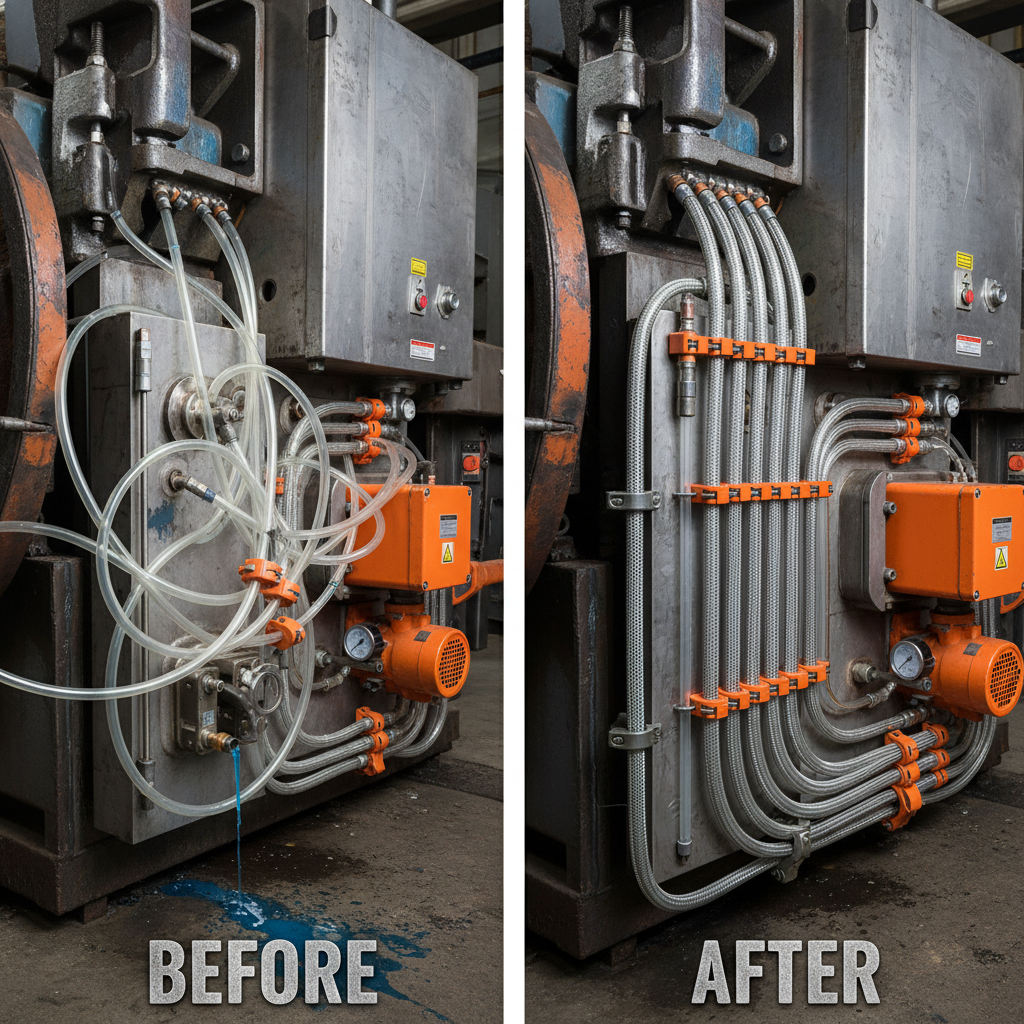
The demand for high-pressure fluid transmission in heavy industry has shifted toward specialized reinforcement architectures to prevent catastrophic system failures. In environments such as deep-hole mining and heavy-duty construction, standard hoses often fail to withstand the pulse pressure and abrasive conditions, leading to unplanned downtime and significant safety risks.
Integrating a custom hydraulic hose solution becomes critical when standard off-the-shelf components cannot match the specific geometry or the extreme pressure surges of a particular machine. The challenge lies in balancing the rigidity required for pressure containment with the flexibility needed for routing through complex chassis.
This technical analysis examines the engineering logic behind spiral-reinforced structures, specifically comparing the EN856 4SP and 4SH standards, and provides a framework for engineers to select the optimal hose configuration based on application-specific stress factors.


Unlike braided hoses that are suitable for lower pressures, spiral-reinforced hoses utilize multiple layers of steel wire wrapped in opposite directions. This construction creates a robust wall that resists the radial expansion caused by extreme internal hydraulic pressure.
The architecture typically consists of a synthetic rubber inner tube for chemical compatibility, the spiral steel reinforcement for structural strength, and a weather-resistant outer cover to prevent abrasion and UV degradation.
The EN856 standard defines the requirements for high-pressure hoses. The 4SP variant is characterized by its wide range of internal diameters, from 1/4 inch to 2 inches, making it versatile for a broad spectrum of industrial machinery where high pressure is required but space may be limited.
The 4SH variant is specifically engineered for heavy-duty workplaces, typically ranging from 3/4 inch to 2 inches in diameter. It is designed to handle higher peak loads and provide greater stability in mobile hydraulic equipment where dynamic stress is constant.
Choosing between these two depends on the specific balance of flexibility and pressure capacity. While 4SP offers a more expansive size range, 4SH provides the structural density required for the most aggressive mobile operating environments.
The primary engineering challenge in high-pressure systems is the management of pressure surges. When a valve closes rapidly, a "hydraulic hammer" effect occurs, sending a shockwave through the hose that can cause localized fatigue in the reinforcement layers.
Rigorous testing, including burst pressure evaluation and flex fatigue assessments, is essential to define the safe operating limit. This ensure that the hose can withstand repeated cycles of pressurization and depressurization without developing internal wire fractures.
Evaluating a high-pressure hose requires looking beyond the maximum working pressure. Engineers must consider the relationship between the reinforcement density and the minimum bend radius, as an overly rigid hose can create excessive tension at the connection points.
The following assessment provides a relative engineering rating of different hose configurations based on their ability to handle pressure, flexibility, and resistance to external wear.
In oil field development and mine hydraulic supports, hoses are exposed to extremely corrosive fluids and mechanical impacts. The use of a synthetic rubber inner tube that resists mineral oils, gasoline, and glycol solutions is mandatory to prevent internal degradation and leakage.
For mobile hydraulic platforms and heavy excavators, the EN856 4SH variant is preferred due to its ability to maintain structural integrity under continuous bending and dynamic load fluctuations. This reduces maintenance intervals and prevents sudden failures in remote operational sites.
The industry is moving toward the integration of advanced polymers that can offer higher chemical resistance while reducing the overall weight of the hose assembly. Reducing the mass of the hose without compromising the burst pressure is a key goal for the next generation of mobile machinery.
Research is also focusing on improving the bonding process between the steel wire and the rubber matrix. Better adhesion prevents the "delamination" of layers under extreme pressure cycles, which is a common cause of premature hose failure.
As automation increases in mining and construction, there is a growing requirement for hoses that can be integrated with smart sensing sleeves to monitor wear and pressure in real-time, transitioning from reactive to predictive maintenance.
Selecting the correct hose requires a detailed analysis of the working environment and the specific hydraulic fluid being used. The choice between 4SP and 4SH should be based on the frequency of dynamic movement and the peak pressure requirements of the system.
The following matrix provides a decision framework for engineers to match the hose configuration with the expected operational load and the application environment.
It is recommended to verify all final specifications against the manufacturer's technical data sheets to ensure that the safety factor is maintained across all operating temperatures.
| Configuration Type | Reinforcement | Primary Metric | Recommended Use Case |
|---|---|---|---|
| Standard 4SP | 4-Layer Spiral | Versatility | Industrial Presses |
| Heavy-Duty 4SH | 4-Layer Spiral | Peak Load | Mobile Excavators |
| High-Flex Profile | Optimized Spiral | Bend Radius | Compact Machinery |
| Corrosive-Resistant | Coated Steel | Chemical Life | Oil Field Development |
| Extreme-Pressure | High-Density Spiral | Burst Safety | Mine Hydraulic Support |
| Baseline Industrial | Braided/Spiral | Cost-Efficiency | General Lifting |
The primary difference lies in their application focus and size ranges. EN856 4SP offers a broader range of inside diameters (1/4" to 2"), making it highly versatile for various industrial settings. EN856 4SH is specifically designed for heavy-duty mobile applications (3/4" to 2"), providing superior stability and strength to handle the fluctuating pressures and dynamic loads common in mobile machinery.
Yes, they are designed for a wide range of fluids including petroleum-based hydraulic fluids, mineral oils, gasoline, fuel oils, lubricating oils, emulsions, glycol solutions, and even water or air brake fluids. However, the specific chemical compatibility of the inner tube should always be verified against the fluid's chemical properties to prevent degradation.
Spiral reinforcement uses steel wires wrapped in opposite directions, which creates a more rigid wall that better resists radial expansion. This prevents the hose from elongating under high pressure, significantly reducing the risk of the hose pulling out of its fittings or bursting under extreme surges, which is critical for operator safety in high-pressure environments.
Common causes include external abrasion, exceeding the maximum working pressure, and improper bend radii that cause stress concentration at the couplings. Internal failure often results from chemical incompatibility with the fluid or fatigue caused by excessive pressure pulses (hydraulic hammer), which can eventually fracture the steel reinforcement wires.
Selection depends on the required flow rate and the allowable pressure drop. An undersized hose increases fluid velocity, leading to higher pressure drops and potential overheating. Conversely, an oversized hose may be too rigid for the application. Engineers should calculate the flow velocity and match it to the available inside diameter ranges of the EN856 4SP or 4SH standards.
The outer cover is the first line of defense against the environment. It protects the steel reinforcement layers from moisture (which causes corrosion) and physical abrasion from rubbing against machine parts. It also provides resistance to UV radiation and ozone, ensuring that the hose does not crack or perish when exposed to outdoor conditions in construction or mining sites.
The transition toward higher operating pressures in heavy machinery necessitates a move away from general-purpose hosing toward precision-engineered spiral structures. The data indicates that the ability to distribute pressure evenly across four layers of steel reinforcement is the most effective way to mitigate the risks of fatigue and burst failure in extreme environments.
For organizations managing fleets of excavators or mining supports, investing in a custom hydraulic hose strategy—focusing on the specific EN856 4SP/4SH requirements—will lead to reduced maintenance costs and enhanced operational safety across the entire hydraulic circuit.